The Path to Zero Malaria Must Be Rooted in Africa Country leadership, Science and Communities
By Pr. Isabella Oyier, Head, Biosciences Department, KEMRI-Wellcome Trust Research Programme (KWTRP) and Science and Innovation Board Member of the RBM Partnership to End Malaria
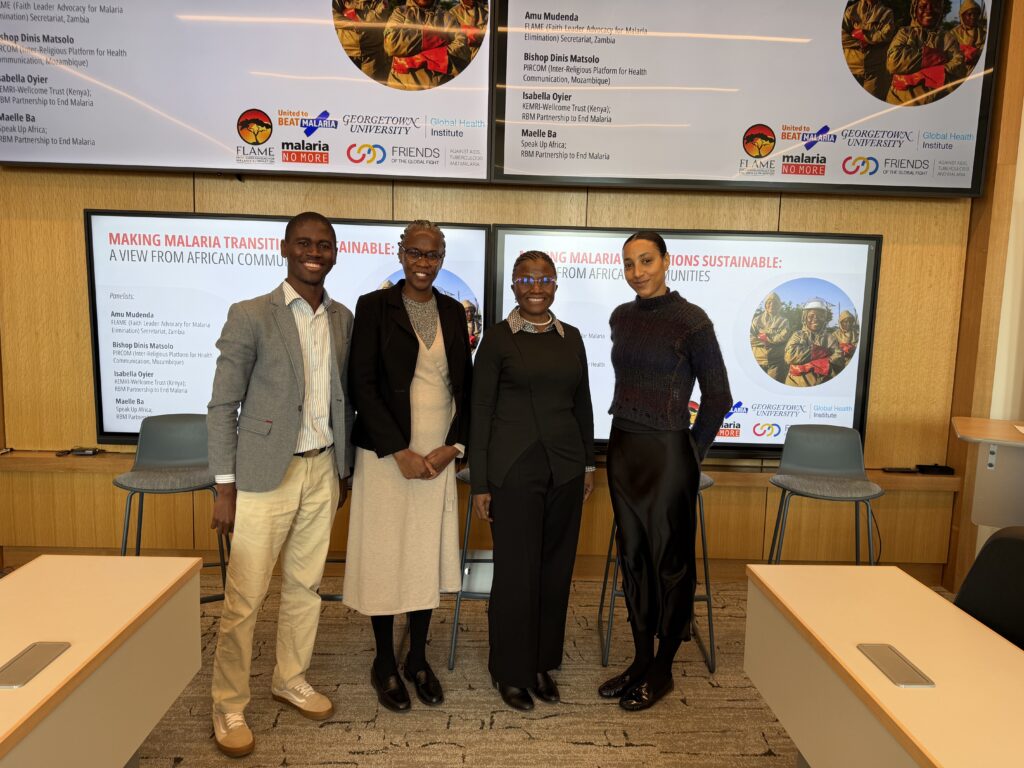
Last week in Washington, DC, I had the pleasure of joining an amazing delegation of African advocates that included Maelle Ba, RBM Partnership to End Malaria’s Co-Chair of the Advocacy, Communications and Resource Mobilisation Partner Committee and Speak Up Africa senior communication manager, three faith-based leaders from Mozambique and Zambia, convened by advocates from Friends of the Global Fight Against AIDS, Tuberculosis and Malaria. Over three impactful days, we engaged in malaria advocacy peer learning discussions, advocacy meetings with the U.S. Congress and administration and a public policy panel discussion at Georgetown University on how to make malaria transitions sustainable. The visit was timely, substantive and deeply revealing. It reinforced for me how the elimination of malaria can be the exemplar disease to demonstrate Africa’s ability to strengthen its health system even as global health undergoes its current transition towards greater Africa ownership. It is a unique opportunity for Africa to lead the narrative of their own national health agenda. Malaria is a preventable disease (with bed nets & indoor insecticide interventions) with a diagnostic tool that works (offering early detection of the infection) plus the effective treatments (allowing for the rapid clearance of the malaria infection). We know what it takes to ensure that our progress in malaria control is not only maintained but accelerated.
I started doing malaria research in 2002, a time when the local hospital we (KWTRP) collaborated with to conduct malaria research had 2 to 3 children per ICU bed with severe malaria. Currently, conducting severe malaria research in Kilifi is impossible as these wards no longer have sick children with severe malaria, while malaria cases dropped by a whopping 49% between 2000 and 2010. This reflects the global figures that show a phenomenal, 51% reduction in malaria deaths between 2000 and 2025. Clear evidence that elimination is on the horizon. However, the minimal reductions in the disease burden over the last 5 years of 7% and since 2020 a rise in malaria infections show progress is slowing down. Furthermore, I am deeply concerned as it underscores the fragility of all the gains made and it draws our attention to a potential of resurgence if the trajectory continues and a terrifying return to my early days in malaria research. Therefore, the urgency of malaria elimination must remain a priority to sustain the progress now, towards significantly bending the malaria curve to zero.
What is abundantly clear is that malaria is not only a public health issue. It is a test of strong governance, accountability, increased domestic financing and local partnerships. This is why as the global health landscape evolves, malaria can serve as a clear indicator that true investment in one’s own health ecosystem can result in national sovereignty and growth in Africa. Important strategic choices now will pay great dividends for a healthy future for Africa. Thus, the right choices matter. Global health transition cannot simply be understood as a fiscal shift or the gradual withdrawal of external support; it must be understood as a broader political and institutional process. It demands that Africa courageously sets and implements visionary priorities and remains accountable to the communities, who yearn for a functional health system, to reap the benefits.
Too often, transition is framed narrowly in financial terms. However, in Washington, our message was clear: sustainable malaria transition must be tied to readiness, stakeholder inclusion, domestic accountability and the protection of previous gains. This is especially important as the new bilateral health agreements and country implementation plans begin to shape how country ownership and co-financing (moving to full domestic financing) are operationalized in practice. The real test will be how these commitments are translated at country level: the priority-setting process, assessments and mitigation of risks, delivery of uninterrupted malaria services and an implementation that reflects the uniqueness of our health ecosystem that involves several partners and stakeholders (a whole community approach). Therefore, safeguarding the malaria control interventions our communities depend on most from mosquito net distribution, seasonal malaria chemoprevention, maternal chemoprevention services and community health worker programs to available and accessible malaria diagnostics and antimalarial treatments. It also means ensuring that civil society, scientists, and community-based organizations and all relevant stakeholders have a seat at the decision-making table, particularly when implementation plans are being developed and monitored. Without these voices, transition risks becoming disconnected from the people it is meant to serve. For malaria, if the transition outpaces health system readiness, the stakes are extremely high, with the looming resurgence already described.
The RBM partnership to end Malaria’s Big Push six-pillar framework convenes and coordinates a well-structured plan to accelerate our progress to zero malaria cases and deaths. Pillar 5 calls for the development and rapid introduction of new fit-for-purpose tools. Pillar 6 focuses on protecting malaria financing and advocating for new resources. These two priorities are inseparable. At country level preserving the current malaria control tools while preparing for new tools is an imperative, thus funding for research and development must be treated as a central pillar of the malaria fight. Protecting malaria financing also means protecting the innovation pipeline that will determine whether we can outpace resistance, respond to shifting malaria transmission patterns and stay on the path to zero malaria. Maelle reinforced the linking high-level advocacy to country realities, stronger resource mobilization, innovation and sustained political attention to malaria as important elements that should remain as top priorities of the any health agenda.
Together we both agree that as the malaria biological threats: antimalarial drug, diagnostic and insecticide resistance and climate change continue to challenge the progress made decision-making must be informed by African evidence and African expertise. This is why initiatives such as African Voices of Science: The Path to Zero Malaria, are so timely. They help ensure that scientific leadership from the continent informs both national decision-making and global advocacy.
Washington was therefore more than an advocacy visit. It was a reminder that the important path to realizing malaria elimination will depend on a collective approach that connects science, financing, inclusive governance and decisive country leadership more effectively. If we do this well, our transition into financing our own health systems will be a defining moment of remarkable transformation, with malaria, one of the leading causes of morbidity and mortality in Africa, relegated to history.
Success will be a resounding victory for our health system and a show of strength and resilience for Africa.
Date of publication
Category
Program