What the Wrong Map Costs Us
By Yacine Djibo, Executive Director, Speak Up Africa and Fara Ndiaye, Deputy Executive Director, Speak Up Africa
We joined Africa No Filter to call time on distorted world maps that shrink our continent. With the African Union’s backing, we can turn a viral idea into education standards – and into better results for Africa’s development.
As global leaders gather this week at the World Education Forum to reimagine the future of learning, there is a fundamental question we are not asking: What if one of the most basic tools we use to teach the world is wrong?
For more than 450 years, classrooms, newsrooms, and boardrooms have relied on the Mercator projection to understand geography. Designed in the 16th century for maritime navigation, it was never intended to represent the world fairly. Yet it became the default.
The result. A profound distortion with Africa, the second-largest continent on Earth, appearing almost the same size as Greenland, despite Africa being fourteen times larger. The error is that the size of the West is enlarged resulting in the Global South, where most of humanity lives, being visually compressed and pushed to the margin in comparison.
This is not just a cartographic problem. It is an education problem.
Maps are among the first ways children learn to make sense of the world around them. They shape how we understand scale, importance, and possibility. When Africa is consistently shown as smaller than it truly is, the message is subtle but powerful: this continent is peripheral. Less central. Less important.
That message follows us into how we think about investment, innovation, leadership, and global priorities. A continent that appears smaller is more easily overlooked, in policy decisions, in funding allocations, and in global narratives.
In that sense, the map becomes an infrastructure of our global perception of the world.
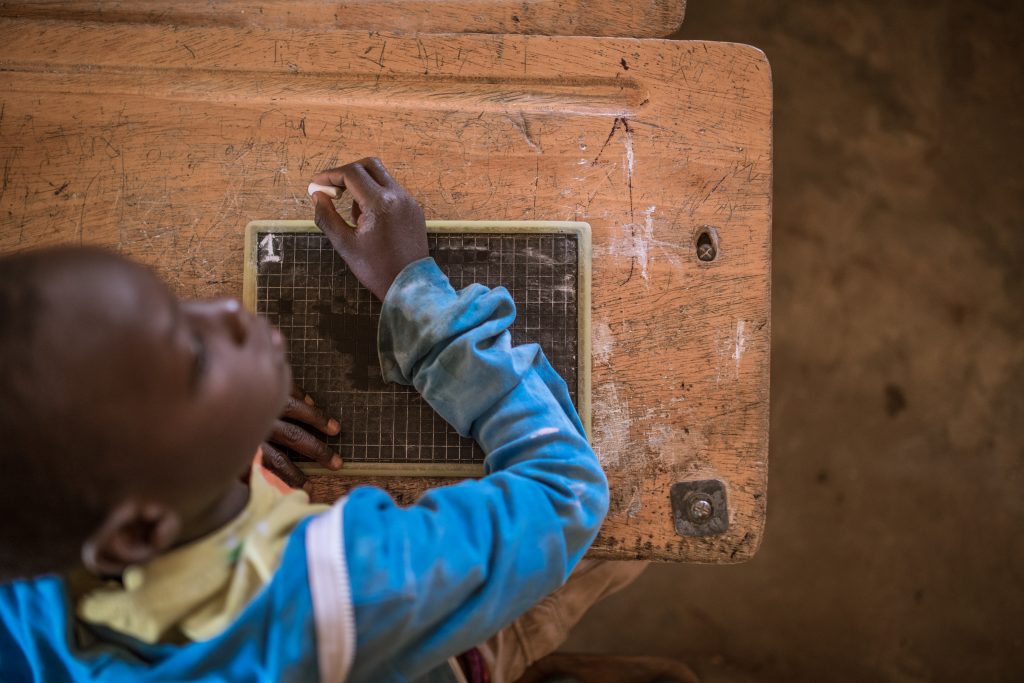
Across many African education systems, this distortion is part of a broader pattern: knowledge frameworks historically shaped from outside the continent. Students often learn about the world through tools, languages, and references that are disconnected from their lived realities.
And the consequences are real.
In global health, for example, underestimating Africa’s scale can contribute to underestimating the reach of diseases like malaria or neglected tropical diseases, and ultimately to underinvestment. More broadly, when Africa’s demographic, geographic, and ecological weight is visually minimized, it becomes easier to misjudge its role in addressing global challenges, from climate change to energy transitions to food security.
This is why the Correct the Map campaign matters. Launched by Speak Up Africa in partnership with Africa No Filter, and now endorsed by the African Union, it calls for the adoption of more equitable map projections, such as Equal Earth, in classrooms, media, and institutions.
We understand there are many map projections, each designed for different purposes, and none is perfect and Equal Earth itself has limitations. But it does offer a more balanced representation of the world, one that respects the true proportions of continents while remaining accessible for education and communication.
Our goal is simple: fairness.
We want future generations to learn from tools that reflect reality, rather than distorting it. We want Africa to be seen, by its own people and by the world, in its full scale, diversity, and significance.
And the timing matters.
Africa is becoming the demographic center of the world. Within a generation, one in four people on Earth will be African. At the same time, the new generation is questioning the systems they have inherited, asking why their education has often reflected perspectives from elsewhere more than their own realities.
The correct the map campaign speaks directly to this generation. It is a visible, teachable, and immediate way to challenge outdated narratives and to begin reshaping how knowledge is constructed and shared on our own terms.
The support of the African Union marks a critical turning point. It transforms what began as a cultural and civic call into a political signal: Africa is asserting its right to be represented fairly.
As ministers, educators, and policymakers meet at the World Education Forum, we call on them to take practical steps to
- Integrate equitable map projections into national curricula
- Update textbooks and teaching materials
- Align media and institutional standards with more accurate representations
Correcting the map is the foundational step towards rebalancing how the world is taught, and how it is understood. Because if we are serious about transforming education for the 21st century, we cannot continue teaching a 16th-century view of the world.
The way we draw the world shapes the way we value it.
It is time to draw it right.
Sign the petition to Correct the Map here