Who Shapes the Future of African Health?
The future of African health may hinge on the answers to these three questions: Who owns the data? Who finances the innovation? Who sets the rules?
These questions underpin some of the most consequential debates unfolding across the continent and globally today. They shape discussions on pathogen access and benefit-sharing, genomic databases, local manufacturing, artificial intelligence, regulatory harmonisation, and the financing of health research and development. They will also determine whether Africa remains a passive participant in the global health architecture, or becomes a co-creator of the policies, technologies and institutions that will define its health future.
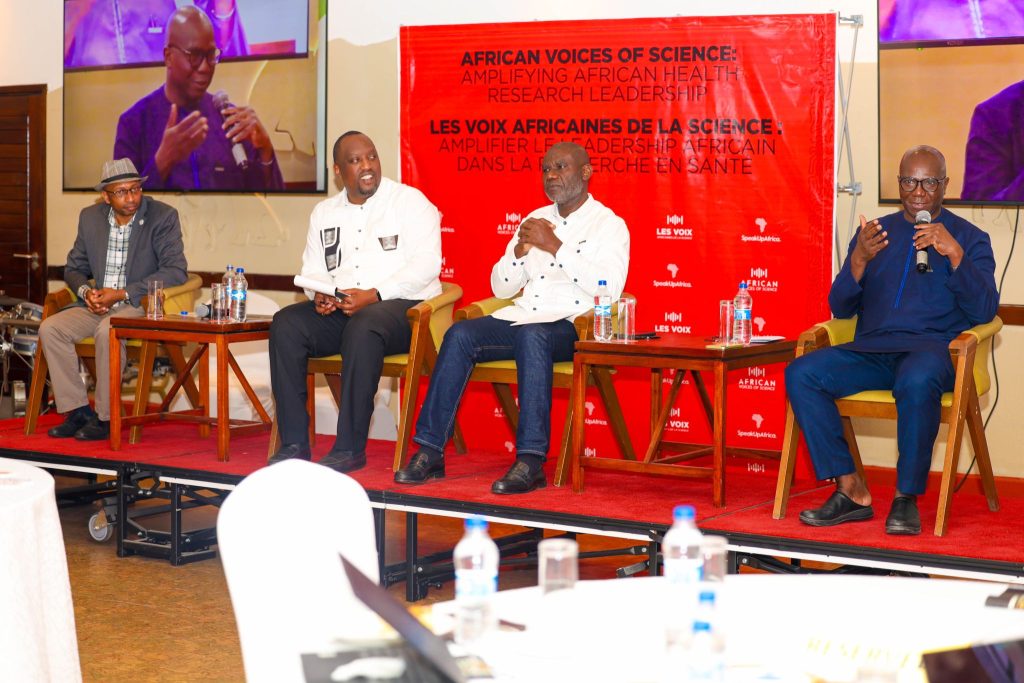
These questions surfaced repeatedly throughout the inaugural Meet the Experts Series, convened virtually through the African Voices of Science (AVoS) initiative from 27 October to 2 November 2026. Although the discussions centred on genomics, health financing and artificial intelligence (AI), they converged around a shared challenge: how Africa can move beyond generating knowledge to shaping policy, attracting investment and driving lasting impact.
Is Africa capturing sufficient value from the science it generates?
During discussions on genomics and research partnerships, speakers reflected on the continent’s “innovation gap”, described as the distance between scientific discovery and practical application by Dr Robert Karanja, Founder and Executive Director of Biolinx Africa, and AVoS Champion. Africa is generating increasing volumes of high-quality research, yet too often the benefits of that research are realised elsewhere. That tension was captured powerfully in a question posed during the session: “What is in it for Africa?” Ms Glaudina Loots who is a Health Innovation Specialist working with the South African Medical Research Council and University of Pretoria, who is also an AVoS Champion.
This question is at the center of current debates on equitable partnerships, data governance and the future of scientific collaboration. It also surfaces in negotiations on pathogen access and benefit-sharing (PABS), where African countries are challenging long-standing models of knowledge extraction. The challenge is ensuring that African data, expertise and resources create value that strengthens African institutions, economies and health systems.
The discussions also highlighted the value of breaking down silos. A partnership that began through connections within the AVoS network has since secured US$3.5 million in funding, and participants used the Genomics and African Research Partnerships session to identify collaborators, expertise and new opportunities. The lesson from this is that stronger connections across the continent’s research ecosystem can unlock opportunities that no single institution can achieve alone. Africa is not short of talent, knowledge or ambition; however, too often these assets remain disconnected.
Is Africa financing its scientific ambitions in ways that match their importance?
The discussion on resource mobilisation challenged long-held assumptions about research funding. As one speaker observed, Africa has become remarkably effective at generating papers. The more difficult question is whether the continent is equally effective at generating products, companies, patents, policy change and improved health outcomes.
The most memorable image came from Mr JohnPaul Omollo, who is an AVoS Champion and a public health professional and health strategist. He compared the research ecosystem to a traditional three-stone cooking fire. Remove one stone and the pot falls. Sustainable progress requires all parts of the system to work together – researchers, policymakers, investors, institutions, and communities.
Discussions also highlighted a familiar cycle: investment often arrives only “when the house is burning,” as Dr Christian Rusangwa, Technical Assistance Director of Muso Health and AVoS Champion, put it. Health and health research remain too frequently treated as crisis expenditures rather than long-term strategic investments. Yet, resilient health systems are built before emergencies emerge, not during them. Participants challenged African countries to rethink the assets already at their disposal, including data, knowledge, expertise and innovation. The challenge is not merely to secure more resources, but to better recognise and leverage the value of those that already exist.
Who will set the rules governing the future?
Discussions on artificial intelligence and digital health brought a familiar question to the fore: who gets to shape the future? While participants acknowledged AI’s potential to transform health systems, they also stressed the importance of reflecting African priorities, contexts and expertise in the technologies being developed.
On the theme of global negotiations, Caroline Mbindyo, Global Director, Impact and Innovation at Amref Health Africa, observed that AI agreements are often negotiated country by country, potentially weakening Africa’s collective influence. “I think we would be stronger if we negotiated as a continental bloc, that we come as Africa to these conversations, to these negotiation tables,” she said. The test, she added, is whether countries can refuse: “The moment we can say no to things, I think then we are setting the agenda.”
The discussion also turned to what Africa already holds, and how to avoid repeating the extractive patterns seen in other sectors. Dr Elizabeth Wamicha, Founder and Director, Futureproof Consulting, warned that much of the continent’s indigenous knowledge, including traditional medicinal knowledge, has not yet been digitised and could be lost. In her words, “indigenous knowledge is like oil… we are generating a resource that is valuable. So we need to safeguard it.” Participants drew a parallel with minerals, which Africa has seen extracted and processed elsewhere. Data and knowledge, they argued, should be protected, well governed and put to work for African communities as AI technologies develop.
As with genomics and health financing, the issue is ultimately one of agency. Africa’s role cannot be limited to adopting innovations developed elsewhere. The continent must also help shape the governance, standards and decisions that determine how those innovations are used.
This is why platforms such as AVoS matter.
Across all three discussions, on the subjects of genomics, financing and AI, participants returned to a shared understanding that data, technology and scientific knowledge are strategic assets. The policies and partnerships that govern them will shape African health systems for decades to come.
The most important outcome of the Meet the Experts Series was that it created a space where scientists, innovators, policymakers, entrepreneurs and funders could interrogate difficult questions together. What began as a platform for AVoS Champions is evolving into a broader convening space for the health research ecosystem, bringing together voices from within and beyond the cohort to engage with issues at the centre of Africa’s future.
Africa’s global health challenge is not whether it has the research expertise. The continent has that in abundance. The challenge is whether African nations are helping write the terms on which that expertise is used. As the future of global health is being reshaped, it is critical that African voices play a role in determining who owns the data, who finances the innovation and who sets the rules.